
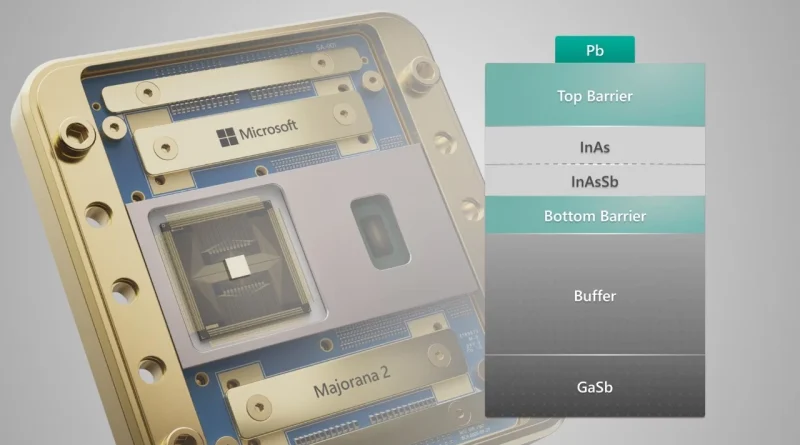
Microsoft Unveils Majorana 2 Quantum Processor with Thousand-Fold Improvement in Qubit Reliability
Microsoft has announced the second generation of its topological quantum processor, named Majorana 2, marking what the company describes as a significant milestone in the race toward practical quantum computing. According to Microsoft’s research team, the new chip demonstrates reliability improvements of approximately one thousand times compared to its predecessor, potentially accelerating the timeline for quantum computers that can solve real-world problems beyond the capabilities of classical machines.
The announcement represents a major step forward in Microsoft’s unique approach to quantum computing, which differs fundamentally from the strategies employed by competitors like IBM, Google, and IonQ. While most quantum computing efforts rely on superconducting qubits or trapped ions, Microsoft has pursued the more exotic path of topological qubits based on Majorana fermions — quasi-particles that were first theorized by Italian physicist Ettore Majorana in 1937 but remained experimentally elusive for decades.
Topological qubits offer a compelling theoretical advantage over conventional approaches: they are inherently more resistant to environmental interference, which causes the quantum decoherence that plagues current quantum systems. In traditional quantum computers, qubits are extremely fragile and can lose their quantum state due to minute temperature fluctuations, electromagnetic interference, or even cosmic rays. This instability requires extensive error correction, with some estimates suggesting that thousands of physical qubits might be needed to create a single reliable logical qubit. Microsoft’s topological approach aims to sidestep this problem by encoding quantum information in the topological properties of matter itself, making it naturally protected from local disturbances.
The original Majorana processor, unveiled in early 2025, represented Microsoft’s first demonstration that topological qubits could actually be manufactured and controlled in a laboratory setting. The company had faced years of skepticism from the scientific community, particularly after a high-profile 2018 paper claiming to have observed Majorana particles was later retracted due to data analysis errors. The successful demonstration of the first Majorana chip helped restore confidence in the approach, though questions remained about whether the technology could scale to practically useful levels.
With Majorana 2, Microsoft appears to be answering some of those scalability questions. The thousand-fold improvement in reliability suggests that the company has made substantial progress in both the materials science and engineering challenges involved in creating stable topological qubits. Quantum computing experts have noted that such dramatic improvements between generations are rare in the field, where progress is often measured in incremental percentage gains. If independently verified, this leap could position Microsoft’s approach as a serious contender in the quantum computing race, despite the company’s later start compared to competitors who already offer cloud-accessible quantum systems.
The implications of reliable quantum computing extend across numerous industries and scientific disciplines. Quantum computers promise to revolutionize drug discovery by simulating molecular interactions with unprecedented accuracy, optimize complex logistics and supply chain problems, break current encryption standards while enabling new quantum-secure communications, and accelerate artificial intelligence research. However, achieving these goals requires quantum systems with millions of stable qubits — a threshold that remains years or potentially decades away with current error rates. Microsoft’s progress with topological qubits could potentially compress this timeline significantly if the reliability improvements continue at the demonstrated pace.
Industry analysts note that Microsoft’s quantum strategy reflects the company’s broader pattern of pursuing longer-term, higher-risk technological bets that could yield transformative advantages if successful. While competitors have focused on near-term quantum advantage demonstrations, Microsoft has invested heavily in fundamental research with the goal of eventually leapfrogging current limitations. The company has also been building out its quantum ecosystem through Azure Quantum, which provides cloud access to various quantum hardware platforms, positioning Microsoft to benefit from quantum computing advances regardless of which specific technology ultimately dominates.
Looking ahead, Microsoft has indicated that Majorana 2 represents an important stepping stone rather than a final destination. The company’s roadmap envisions progressively larger and more capable topological quantum systems, with the ultimate goal of achieving fault-tolerant quantum computation at scale. While significant technical challenges remain, the demonstrated improvements suggest that topological quantum computing has moved from theoretical promise to engineering reality, potentially reshaping expectations for when quantum computers will begin delivering practical value across science and industry.